Can You Train AI on Customer Data? GDPR Rules


Say your support team wants to train an AI model to answer common questions. You already have a folder full of past conversations, but customers shared that information so you could help them. Can you use those chats to train a model?
The same question comes up when you ask an AI tool to summarise a support ticket. Before you paste it in, check whether the provider can use that conversation for its own training.
Can you train AI on customer data?
Yes, if you have a lawful basis under the GDPR and any agreement you made with the customer allows it. When you reuse personal data you already hold, check whether training is compatible with the reason you collected it or whether you need fresh consent for the new use.
If you rely on consent, explain what you want to train and make it easy for people to withdraw permission later. If you rely on legitimate interests, document why you need the data and weigh your reasons against customers’ rights and what they’d reasonably expect. The European Data Protection Board’s guidance on AI models explains how to make that assessment. For sensitive information such as health data, you also need an exception under Article 9. Explicit consent is one option.
A customer who shares an order number so you can track a delivery may have no reason to expect that chat to become training data. That’s where purpose limitation comes in. Under Articles 5(1)(b) and 6(4), look at how closely training relates to the original purpose. How you collected the data and what the new use could mean for the customer matter too. Write down your reasoning before you train.
Tell people about the new use before you start. Articles 13 and 14 set out what to tell them, so update your privacy notice and check that it actually reaches the people whose data you plan to use.
Plan for erasure under Article 17 before training. Removing someone’s record from the dataset is one thing. Working out whether the model still contains personal data from that record can be much harder. Leave out personal details you don’t need, and keep any source records you still need somewhere you can find and delete them.
Can a company sell customer support transcripts as AI training data?
Start with what you promised your customers. If your contract says you’ll use their support chats only to provide the service, selling the transcripts falls outside that agreement.
Even if the contract allows the sale, sharing identifiable transcripts with another company for training is a new use of that data. You need to establish a lawful basis for the disclosure and tell people who will receive their data or what kind of company will receive it. If you’re relying on consent, check that it covers the sale for AI training. Permission to handle a support request doesn’t cover that by itself.
What to check before the first training run
- Start with a small set of tickets you can review by hand.
- Strip out personal details you don’t need. If you replace names with codes that can still be linked back to customers, the records are still personal data.
- Write down why you’re training and what lawful basis you’re relying on. If it’s legitimate interests, keep a copy of your assessment.
- If a model provider will process the data for you, check that your data processing agreement covers the training you’re planning.
If you’re buying an AI tool for your team, ask what the vendor can do with the prompts and files you send it.
Why AI without training on customer data matters
In your daily work with AI tools, you probably enter more than a little text. Customer names. Contract details. Support questions. Internal notes. The question is not whether your data gets typed in somewhere, but where, and what happens to it next.
What happens to your data with ChatGPT and similar tools
Many providers write their terms so your inputs can be used to train models. Your prompt about customer data could end up in the training set for a future version.
The model does not learn instantly, but the next release might surface data you once entered. If someone in Mexico suddenly gets customer details about Hans Kreutzer spat out by the model, the fun is over.
Free vs paid? Not the main point
Many people wrongly assume that paying for a subscription automatically means better privacy.
Wrong.
Even on ChatGPT Plus, training options can still be on unless you turn them off yourself. You need to look deeper than the plan tier if you want AI that does not train on customer data. What matters are privacy settings and what the provider actually commits to.
Individual vs enterprise: where the real line is
The meaningful split is not free versus paid, but individual versus enterprise plans. Personal accounts, including Plus or Pro, often ship without a strong privacy promise by default. Enterprise offerings like ChatGPT Enterprise or Microsoft Copilot for Business more often state explicitly that inputs are not used for model training. The main things to check:
-
Clear terms saying prompts are not used for training by default
-
The same protection for uploaded files, PDFs, and attachments
-
The model providers in the stack (subprocessors) also do not train on your inputs
-
No hidden opt-out toggles or carve-outs via feedback buttons
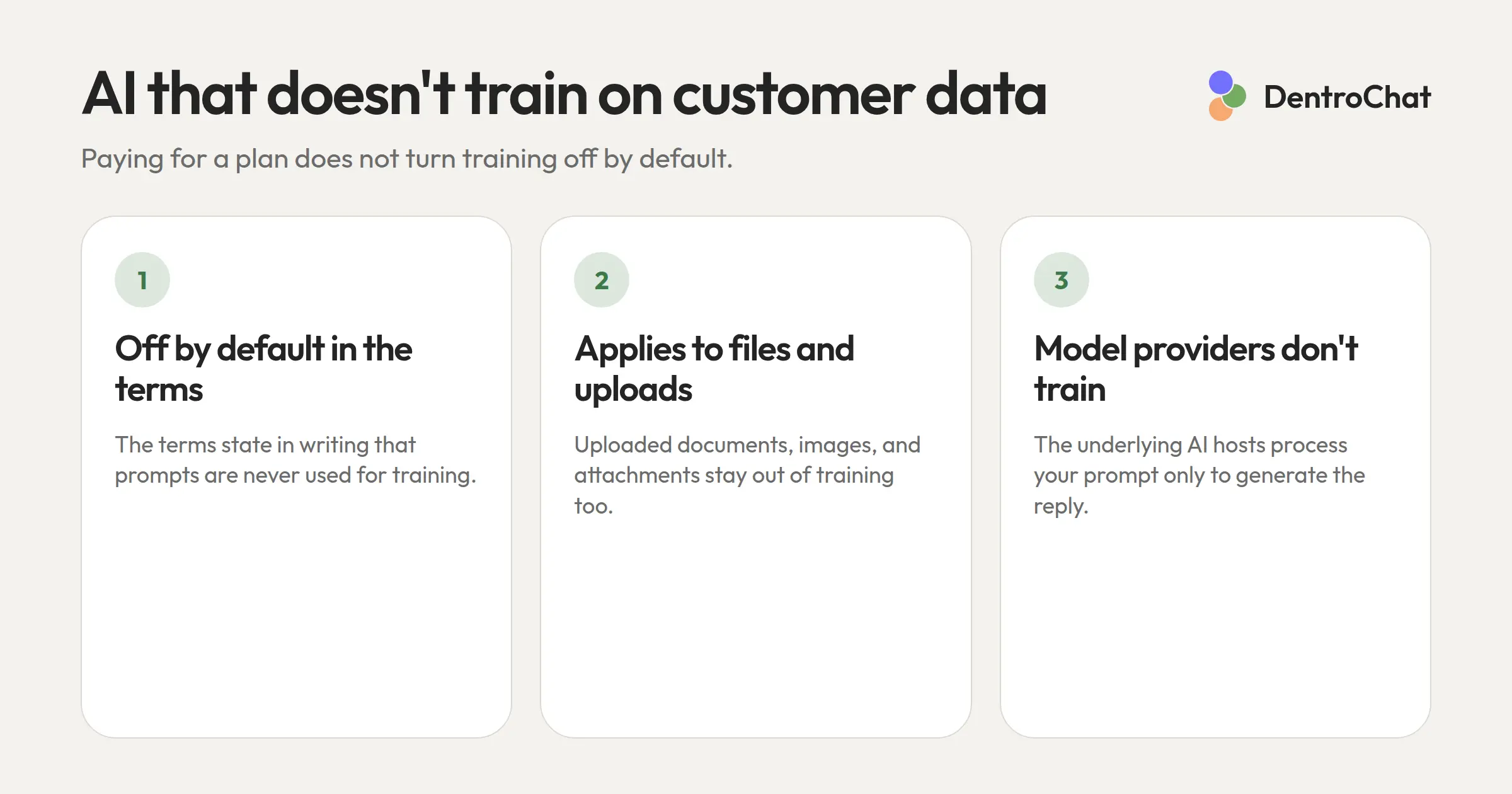
At DentroChat, we don’t use your chats to train AI models.
Legal risks when using AI with customer data
GDPR and AI use
If you use an AI service to handle personal data at work, check that you have a lawful basis and share only what the task needs. If you’re asking for a summary of a support ticket, for example, the customer’s email address probably doesn’t need to be in the prompt. Check who else can access the data and whether the provider can reuse it for training. Our guide to GDPR compliance for AI at work explains what to look for.
US CLOUD Act: why server location is not enough
Many companies assume they are fine because their AI vendor uses servers in the European Union. Server location covers only part of the question.
A US chat can still be a reasonable choice if it does not train on your data. For overall data protection, it is better to avoid US subprocessors.
US companies fall under the US CLOUD Act, which can require them to hand over data to US authorities on request, regardless of where it is stored physically. A server node in Frankfurt does not remove that exposure.
US authorities can also gag the company about the disclosure. That happened 1,823 times at Microsoft in the first half of 2025 alone.
How to spot secure AI tools
What to ask every provider
Before you roll out an AI tool in your company, ask concrete questions:
-
Is model training excluded by default for chats and uploaded files?
-
Does the no-training rule apply to the AI model providers in the background (subprocessors)?
-
How long are prompts kept for abuse review, and who can access them?
-
Where are servers located physically, and which law governs the operator?
A provider that answers these in writing with specifics shows that privacy is built into the product.
What the clause should say
If a vendor says it doesn’t train on your data, ask where the contract or data processing agreement says so. Check that the clause rules out using both prompts and uploaded files to train or improve models, and that it covers any model providers or other subprocessors that handle your data.
While you have the agreement open, look for how long the vendor keeps prompts and files and how it tells you before adding or replacing a subprocessor. A vendor that uses another company’s model should be able to show that its agreement with that company backs up the no-training promise.
If you’re comparing providers, see our list of GDPR-compliant AI chats that keep data in the EU. Our guide to AI that doesn’t train on your data explains how to check what a provider’s promise actually covers.
Even without training: retention for abuse review
Even when model training is off, many large providers do not delete your input right after the reply. Plenty of services keep prompts for 30 days or longer for abuse and safety review, sometimes with access by trained reviewers. If you enter confidential customer data, check how long inputs are logged, whether old chats can auto-delete, and who gets access in a support case.
Red flags in the terms of service
Certain phrases should make you stop immediately. Wording like “to improve our models” or “to enhance our AI” applied to your inputs and chat content means your prompts can end up in future training data. Watch out: some vendors use similar language that only refers to anonymous usage statistics, not chat content. Context always matters, see what “improvement” actually refers to. Vague privacy policies with no storage location or retention periods, or no way to opt out of model training, are bad signs too.
A clear privacy policy tells you whether your chats are used for training and where your data is stored. In our privacy policy, we spell out our no-training commitment and show where each of our subprocessors is based.
If you cannot find such clear statements, that is already an answer. If you do not want to read a foreign privacy policy line by line, our Privacy Policy Analyzer helps you spot training clauses and third-country transfers quickly.
Using AI more safely: practical strategies
Even without a perfect tool, you can make your AI use safer immediately. Two measures have the biggest impact.
Anonymise data before you type
When you write a prompt, replace real names, companies, and contact details with simple placeholders like “Customer A” or “Company X”. It can feel clumsy, but it takes seconds and cuts risk sharply, especially if you lack a tool that explicitly promises not to use inputs for model training. For routine tasks like draft text or summaries, anonymisation is often enough.
Internal rules for your team
Individual caution helps little if colleagues paste customer data into random AI tools. Put in writing which data types may go into which tools and which are off limits. EU regulators expect technical and organisational measures as part of every AI deployment. Short team trainings raise awareness without slowing work.
Frequently asked questions
Can you train AI on customer data under the GDPR?
Yes, if you have a lawful basis and your customer agreement allows it. If you collected support chats for another purpose, check whether training is compatible with that purpose or whether you need fresh consent.
Can a company sell customer support transcripts for AI training?
Only if the sale is allowed under the customer agreement and the company can lawfully share the data for training. If the company relies on consent, that consent must cover the sale. Agreeing to share information with a support team doesn’t mean agreeing to have the transcript sold.
Does a paid plan stop a vendor from training on your data?
Not necessarily. Paid personal plans can still allow training, so check the settings and terms for your specific plan. If you’re buying for a team, ask the provider to point to the no-training clause in the agreement.
Which AI platforms commit in writing not to train on customer data?
At DentroChat, we don’t use your chats to train AI models. We say so in our privacy policy. When you compare providers, check whether their promise also covers uploads and applies to the model providers that process your data. Check data retention separately, because a no-training promise doesn’t tell you how long a provider keeps your chats.
DentroChat: AI without training on customer data
We built DentroChat for teams that want to use AI at work without having their chats used for model training.
How DentroChat handles privacy
We process data in the EU and Switzerland and don’t use US-based subprocessors. You can see who handles your data on our subprocessor list.
Who benefits most
This is especially useful if your team regularly handles sensitive customer information or contracts. When you use DentroChat to summarise a customer email or review a clause, you can check where that information goes and what we use it for.
AI without model training on customer data is not a nice-to-have. It is a baseline every business AI use should meet when real customer data is involved. GDPR, the US CLOUD Act, and rising customer sensitivity mean setting the direction now beats expensive fixes later.
Your next step can be quick. Read the terms of your current AI tools. Ask the questions from this article. If the answers are vague or missing, you know what that means.